menu

Yes, it is possible to market your blog without social media. Whether you want to do it permanently or just temporarily to take a break from Instagram and TikTok, making sure you set up your business to have that capability is so important.
P.S. Just to reallyyyy entice you: you don’t need video on Pinterest at all, so if you’re burnt out from being a video editor when you got into this to be a writer… let that sink in!
I know bloggers and content creators are feeling incredible burnout these days. Social media can be incredibly overwhelming and “doom-scrolling” is hard to avoid when your job requires you spend time on social media.
We’re all experiencing social media fatigue because keeping up with the algorithm changes and new features is exhausting. I’m much more of a writer than a short form video girl, but if I want to be on TikTok and even Instagram… I have to completely switch up my natural communication. I have to force myself to do something that’s hard and requires so much more energy. When you feel like that, the time it take to create social media content just seems to grow and grow.
I’ve seen a lot of this sentiment from bloggers who have begun returning back to blogs and e-mail newsletters (or Substack). They are tired of showing up daily for their content to last 24 hours and reach a fraction of the people it once did. I’d like to propose an option for bloggers to market their blog without Instagram. If it’s something you’re considering for your mental health or just to feel more excited about work each day… I’m here to help!
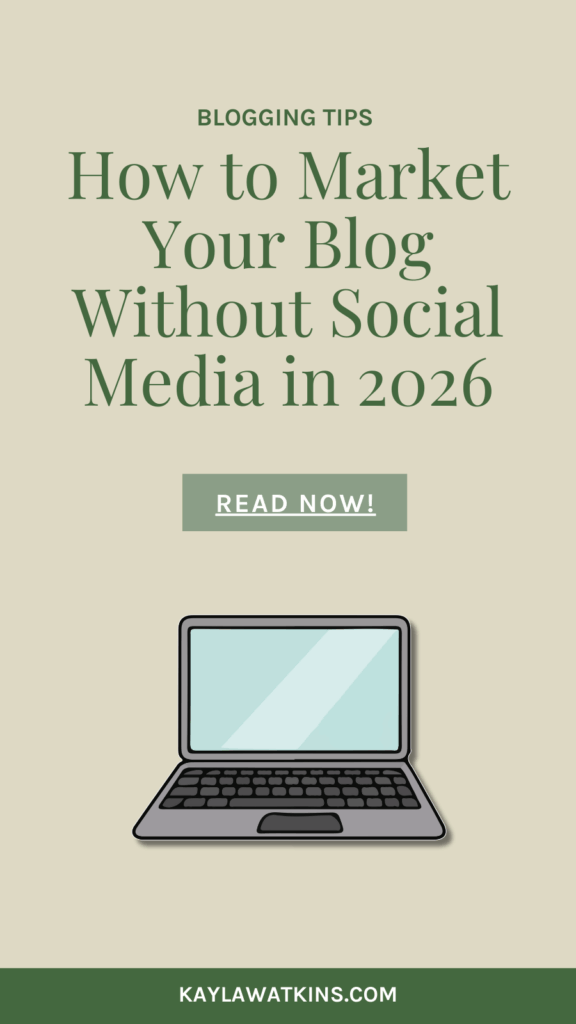
Okay, just to make sure you realize this right out the gate… otherwise you might be confused about why I’m suggesting Pinterest as an alternative to social media marketing. Pinterest is really a search engine, not a social media platform. That is because Pinterest is not about users socializing with each other. Pinterest is about users finding useful, beautiful, interesting content and saving it to their boards or clicking through to get more info and leave the platform. It’s about people typing what they want in the search bar and Pinterest’s algorithm being able to bring up options for content that fits that search.
People are not on Pinterest to find personalities they enjoy or a community to interact with. They want information, inspiration, ideas, products to shop, etc. That’s a big difference from seeing opinions, personalities, comments, etc. like you do from your average scroll on social media.
Content that performs best on the platform is content that serves the audience and helps them solve a problem, plan an event, create something new, find the right product to purchase, give them ideas or inspiration… content that serves does best.
It also works like other search engines (ahem, Google) where your content last far longer than 24 hours. Most of our clients have had pins that drive daily traffic to their blogs for years. They have all also had pins pick up weeks, months or years after making it. This means time spent on the platform is time well-worth it.
Also, there is no need to show up daily on Pinterest. While yes, I always recommend a “Bare Pinimum” of 3 pins/day, this is each to schedule out and does not require creating from scratch. It requires repurposing which takes a heck of a lot less energy that creating fresh content daily or having to be all made up and ready to go with a script.
If you’re like, okay, Kayla, tell me more. I want to walk you through how this could look for your blog and the exact content funnel I’d recommend to make it as low-lift as possible to create blog content and then promote that blog content. It’s so important to not just have a plan for staying consistent with writing blog posts, but also for staying consistent with getting people to said blog posts. You want to make sure the content you’re taking so much time to write is getting seen.
Here’s the big difference: we’re shifting away from social-first marketing and prioritizing search engines. That way social can either be a small part of your marketing (if you have the capacity to do so) or can be removed completely, especially in busy seasons.
When it comes to social-first marketing you have to chase trends, use popular sounds, keep abreast of algorithm tactics (hashtags or no hashtags), prioritized formats (short form videos? carousels?) and fit your creativity into these molds.
When you’re doing search-first marketing you can rely on what has consistently performed well in terms of keywords or topics OR you can even just find the right keywords to define the topic you just are interested in creating about. If you master merging what you want to write about with what people are actively, consistently searching for you… you have blog content that will perform year after year.
The other mindset shift you need when it comes to search-first strategy is that you’re not longer creating content for it to expire in 24-48 hours. Instead of just getting a big traffic hit and then crickets, you’re creating content that will compound over time as more and more people come across it. Traffic will grow and grow as you fine-tune your SEO skills and as the search engines share it with more and more people.
While there’s nothing “passive” about owning your own business, this is as passive as traffic gets for content creators.
First of all, this is NOT my strong suit I believe in it whole-heartedly because 1) it has always worked and 2) I see the analytics of bloggers every month and it’s still working DESPITE there being changes with Google too and AI search results adding a whole new layer to it. The thing is, I consistently see my clients with thousands to hundreds of thousands of visitors per month all have the same top 3 traffic sources: Google, direct traffic and Pinterest.
Google SEO, like Pinterest SEO, is something you can learn yourself and execute on or outsource at varying degrees. Whether it’s just for the keywords you need and the outline or if it’s for full blog writing, I’d really recommend just investing time and/or money into the platform in 2026. Check out my bloggers resource page for educators and service providers in the Google SEO space to learn from or hire.
I’m going to spend the rest of this post on the Pinterest side, since that’s my speciality, BUT both Google users and Pinterest users bring the same thing to your marketing plan: new, qualified leads to your website consistently.
There is also the topic of writing these blog posts to convert well into long term community members or sales. Both Pinterest and Google have specific ways to research this, but the main point is that you want to write blog posts about things people are searching about. That is the fastest way to get traffic from search engines. You find out what people are looking up information for and write about it in the same language (keywords, questions, structure) that they are searching for it. You serve up exactly what they’re searching for on a silver platter.
With Google there is a lot of research you can do, but Pinterest also is an incredible starting point for content idea generation. I really believe that lifestyle bloggers (fashion, beauty, home decor, travel, food and DIY bloggers) should use Pinterest as place to get content ideas. I’ve shared how you can use it to create a blog content calendar and why their Pinterest Trends tool is a goldmine for content ideas.
Start there to find topics that people are searching for in your niche and then address them in the way people are looking to have them addressed. Do they want checklists to help them get their homes cleaned weekly? Are they looking for meal prepping grocery lists to help them stay healthy? Do they want step-by-step tutorials on how to make the fluffiest cinnamon buns?
Create this content with as much heart and intention as you can. If you’re doing a search-first strategy, you have to remember these people are new to you. They do not already know, like and trust you. Your content has to prove to them that they should stay for more content and start to built that KLT factor.
When you’re doing a social-first strategy, they may (temporarily) excuse poor content because they already have a connection with you. They’re more likely to give you a second chance.
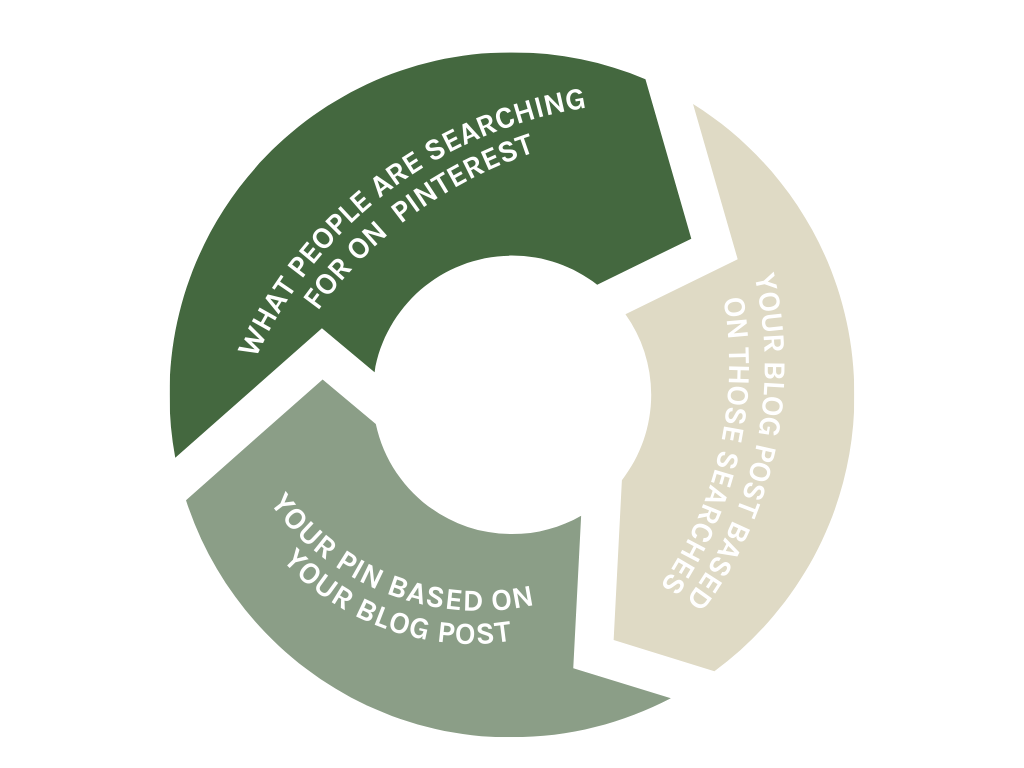
I feel like now is a good time to remind you that SEO is not a quick win. It’s not like going viral. SEO is a long-term play with long-term results. Social media is a short-term play with short-term results. You have to put in a lot of work and time to see the results, but the results compound.
Also, if you turn traffic into e-mail subscribers, the results cannot be taken from you if a platform shuts down or de-prioritizes your content all of a sudden. Again, we’re not just talking about big numbers for the sake of it… we’re talking about people meeting you > connecting with your content > connecting with you > joining your community. All on platforms you own and have complete control over.
I love to do a Instagram vs. Pinterest post, because I’m just so passionately pro-Pinterest BUT I also think when you focus on your business as being the part of the internet you own (content= your website and community= your email list), it becomes such a powerful alternative to social media.
Let’s face it: Pinterest could also disappear overnight BUT the people it sent you that you now have on your email list… these will not disappear. Instagram doesn’t send people to your site or your email list well or passively therefore if the platform disappears so does your entire community.
Pinterest’s goal is to connect people with the content that best matches their search intent and then people leave the platform to get that content. Whether they leave right away with a click or they save and revisit later… people use the platform to find other websites. Instagram does not have that option because links can only be shared temporarily in stories or in your Instagram bio.
Instagram wants you to scroll and scroll on the platform forever while Pinterest just wants your to find the content that keeps you coming back to the platform to find more content. It’s just a totally different user behavior and user intent.
Going with the user behavior vs. forcing user behavior to do something that’s not natural on the platform will give you much better outcomes.
Pins can and will last for years. The shelf life is significantly longer and your ability to post about the same topic or blog post allows you to constantly be repurposing and reusing content rather then reinventing the wheel. This allows you to step off the content creation hamster wheel and just focus on how to strategically repurpose which is much less of a mental lift and much more effective.
This opportunity for consistent traffic is something we all crave to help stay out of the feast and famine cycle and instead by consistently comfortable in our business.
Once you’ve opted into a search-first marketing strategy for your blog, you now need to make a plan for what to do once all of these new people come to your blog. How will your warm them up? How will you (quickly) get them to know like and trust you? Can you make money from a search-first strategy?
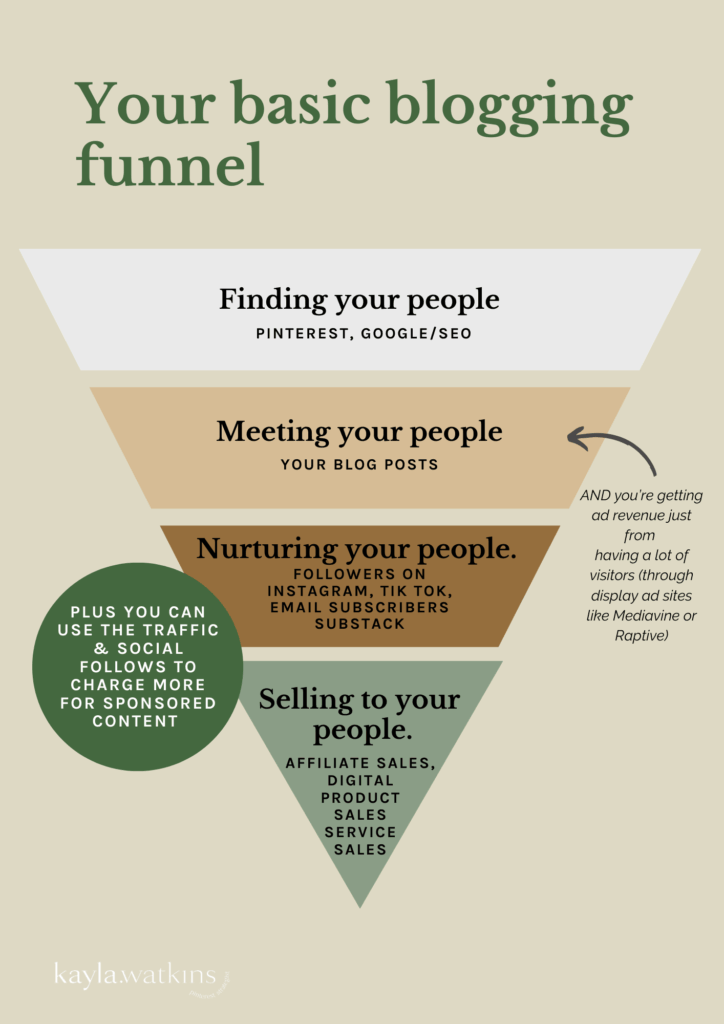
A simple blog funnel looks like this:
The beauty of a blog funnel is that once you set it up, it will automatically keep working for you. You can use email platforms like Flodesk or Convertkit to collect emails, send automatic replies, send your freebies and even structure your email lists into separate entities if you’ve got multiple content buckets.
The easiest way to entice new people to join your email list isn’t just to say “hear from me once a week!” because remember they still don’t know, like or trust you YET. They just got one great piece of content from you, but they don’t know yet whether you’ve got more to offer or not.
Offering a relevant opt-in right away on a topic they were already searching for information about can help move them from reader to fall much more quickly. That will be twice that you delivered or, even better, over-delivered on what they wanted. Not to mention, giving away your email has to be worth it. Often “hearing from” someone you don’t know yet isn’t enough.
Side note: if you want to join our email newsletter, “Pinterest for Bloggers,” we offer a weekly Pinterest trends PDF that is broken down by niche so you know exactly what people are searching for each week.
Opt in ideas for bloggers:
I know we online digital marketer people say this all the time, but the only community you own and have complete control over is your email newsletter community. It’s the only one you can constantly fall back on because it’s the only one that isn’t controlled by someone else.
It’s also the only “platform” that has such a wide range of users and such consistent users. 30 somethings and beyond have all been checking their emails daily for over a decade. We can’t say the same for other platforms. It’s not going anywhere any time soon and requires no extra effort from our community since they’re already checking emails for both personal and professional reason.
This kind of stability and sustainability is something we all want in business, so prioritizing email just makes sense.
Not to mention, sending content directly to your community is a much higher impact and allows for much better connection than hoping an algorithm shows your content to you community. Why would we try to jump through hoops for the hope of our follower to see our content when we could simply press send and know for a fact our subscriber will see our content?
Then they can see not just that one content… but every single other piece we want to share in the foreseeable future. This has been a successful route for marketing for decades for a REASON!
Then you can use your email list to nurture you community by continuing to provide high value content in the areas they’re interested in. They can start to KLT you and then even start to connect with you via email replies because they find not only your content, but your personality interesting and inviting. They’re now a full-fledged fan that waits for your emails and binges new content.
That kind of a community member is invaluable in growing a blogging business because they will read whatever you put out and are open to buying whatever you suggest. The opportunities for both revenue and true community here are endless when you have this kind of email ecosystem running.
In summary, all of these platforms work together to create a full blog marketing plan that does not require social media or your constant attention. While, yes, it’s hard work to run a blog business in general, this route allows for automation and passive income in a way social media doesn’t.
To summarize, you can allow social media to be an optional part of marketing your blog when you use the following platforms to do the following things:
Then, you’re just rinsing and repeating the same cycle!
I hope, by now, I’ve proven to you that social media is not a necessary tool to grow a blog. It’s a great one for nurturing community, but if it has felt too heavy, too stressful or just not aligned for you lately… it’s okay to step back. Using the above funnel and action plan to market your blog will allow you to make social media optional. Whether you want to step by temporarily or permanently, you’ll feel like you can which is incredibly freeing.
Search-first marketing is a calmer and more sustainable way to grow your business. If you care less about follower counts and more about high-value content and quality community-building… this just might be the route for marketing your blog.
If this sounds like a strategy you want to focus on in 2026, but you have no clue where to start when it comes to Pinterest marketing for your blog, please reach out. We support bloggers in growing their communities and repurposing their content in many ways and would love to help!