menu

I’ve been doing Pinterest for 8 years. One of the perks of being in any niche that long is you start to notice patterns before most people are talking about them.
So here’s a pattern I’ve been watching for the last 6 months. There’s a real, measurable shift in how creators are making income and what they’re prioritizing in their business.
I want to walk you through what I’m seeing, where I think Pinterest fits in all of it and (I’ll be really honest with you) the part of this that I’m still actively figuring out alongside my clients.
Two things come up again and again for my clients and others I see on Threads and Instagram:
1. Bloggers are burned out.
Not all of them, but a lot of them. The cycle of writing 2,000-word posts to chase Google traffic that keeps getting harder to earn with all the HCU updates… a lot of folks are quietly stepping back. They’re not “quitting blogging.” They’re putting more energy into the part of their business that pays out more quickly: brand deals and affiliate income (on the affiliate platforms themselves), and less into the long-form.
2. Creators are migrating from LTK to ShopMy.
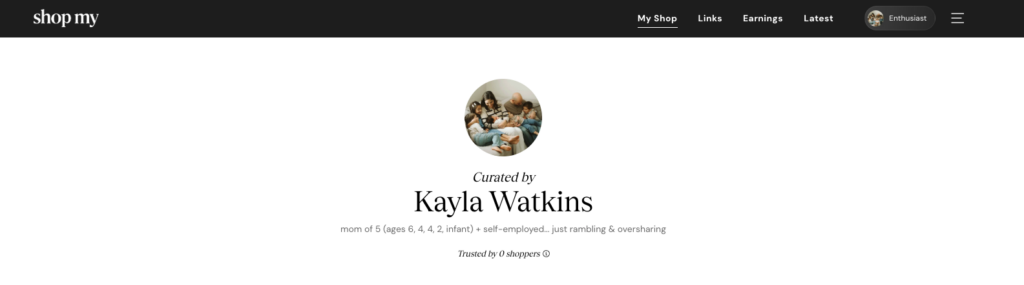
This one is real and accelerating. ShopMy has quietly become the platform creators are switching to from LTK. There was some controversy with LTK earlier this year that frustrated creators, and the rhetoric I hear everywhere is that the conversion is better on ShopMy and the brand deals/gifting opportunities are also better.
If you’re not on ShopMy yet, you’ve at least seen creators in your feed migrating. That’s a shift after LTK being the biggest player for a very long time.
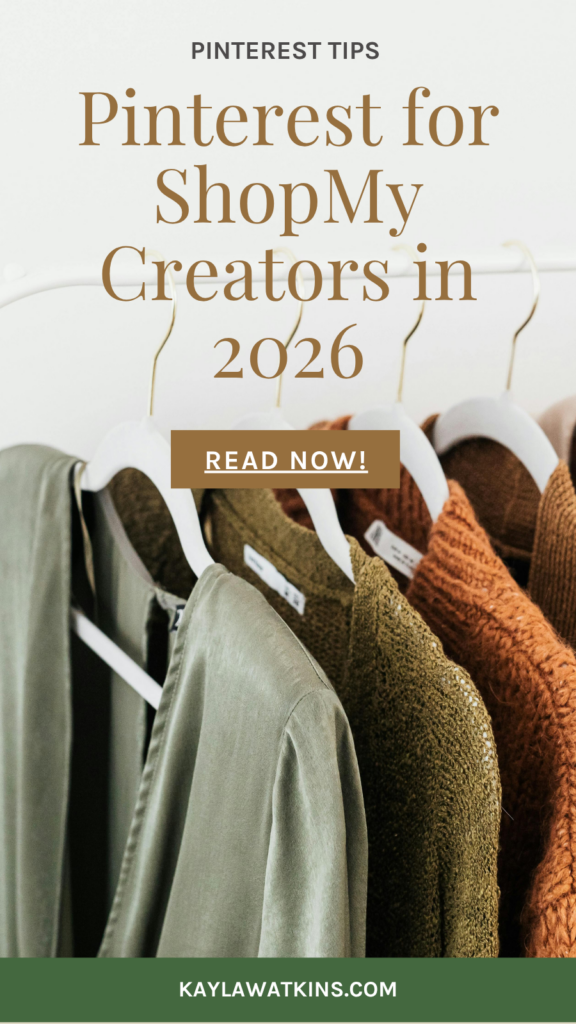
Here’s where my brain goes, because Pinterest is what I do.
For 8 years, I’ve been helping bloggers use Pinterest to drive traffic to long-form content. That work isn’t going anywhere. Blogs still matter. Display ad income from Mediavine and Raptive is still a real way to make income. Pinterest still drives that traffic well. If you’re a blogger, my 2026 Pinterest strategy post still applies to you, exactly as written.
But there’s another type of creator emerging (and growing fast) that I think Pinterest is set up to serve really well, but I hadn’t fully leaned into… until now:
Creators who are skipping the blog entirely and going straight to affiliate income through ShopMy.
These creators are building an audience on social and/or the affiliate platform itself, curating a ShopMy collection and trying to drive commissionable traffic to that collection. No 2,000-word blog post in the middle. No display ads. Just: short-form content → traffic → ShopMy collection → commission.
And the questions they all eventually ask are the same ones bloggers have been asking me for 8 years.
The answer is the same place it’s always come from for lifestyle content: Pinterest.
Pinners are planners. Pinners are spenders. They are intentional. They go to Pinterest with shopping in mind. None of that has changed in 2026, and ShopMy collections (when done right) can be exactly the kind of content they are actively searching for.
So Pinterest as the traffic source for ShopMy creators? That part makes a ton of sense to me.
But….

There’s a piece of this I haven’t fully tested at scale yet, and I want to say that out loud.
I know how to drive traffic from Pinterest. That part I have completely solved. After 8 years of looking at pins every single day, I know why a pin gets traction or doesn’t. I know why a pin drives outbound clicks or doesn’t. I know what’s broken about the way most creators are designing their pins or writing their pin descriptions right now. That’s the proven, repeatable part. That’s why I’m already comfortable charging for an Affiliate Pin Glow-Up.
What I’m still actively learning is the next step in the funnel for these creators.
Specifically: when Pinterest traffic lands on a ShopMy collection instead of a blog post, does it convert the same way? Does it need additional information to warm people up? What style pins work best for sales vs. traffic? Do certain ShopMy link types perform better than others on Pinterest? Are collection links better, or shoppable posts, or direct product links?
I can see early signals. I have hunches. I also see what ShopMy publishes about their own platform and what Pinterest publishes about affiliate links and FTC disclosure. I’ve put all of those together into a working method.
But I haven’t run hundreds of these. So I’m being upfront with you that this is an experiment I’m running with my clients and my own mini-ShopMy profile right now, in real time. I’d rather tell you that than pretend I’ve already cracked it.
What I’m offering creators in 2026 is this: 8 proven years on the Pinterest traffic-driving side, plus actively testing methods on the ShopMy side, while we all figure out the conversion piece together.
Here’s why I’m even doing this.
I went looking for what already existed. I read as much as I could about what ShopMy has published, everything Pinterest has published about affiliate links, and the third-party guides on top of that. (My eyes are tired. lol)
Here’s what I found:
So creators using Pinterest + ShopMy together are basically duct-taping tiny crumb of advice from three different sources and hoping it works.
That’s the gap. And after 8 years tuning Pinterest for bloggers driving traffic to long-form content, the same expertise translates straight over to Pinterest driving traffic to ShopMy collections, if you adjust for the differences. Which is what I’ve been quietly doing for several months and what I’m now formalizing.
These are the 3 pillars I’m focussing on when it comes to driving traffic to ShopMy from Pinterest:
1. Demand-Driven Content Buckets: Pre-validated, high-intent topics. Meaning: we figure out what people are actually searching for on Pinterest WHEN they’re searching for them on Pinterest… before you build content around it, so your ShopMy collections are positioned to perform from day one.
2. Pinterest Traffic Strategy: This is my 8-years-of-Pinterest wheelhouse, retuned for ShopMy creators. Pin design, pin titles/descriptions, profile optimization, board structure, posting cadence… all calibrated for the way Pinterest search has shifted over the years and for the kind of intent ShopMy buyers come in with. This is the part I have solved.
3. Stranger-to-Shopper Strategy: This is the part most ShopMy advice skips, because most ShopMy advice assumes you already have a warm audience that follows you. Pinterest traffic isn’t that. Pinners are searching for something they want, not for you. Pinners care about the content, not about the creator.
How can we warm them up the way the blog post would in the past but with far fewer characters/much more quickly? Sizing notes. Fit context. “Why I picked this.” Who it’s for, who it’s not for… This is the working theory I’m actively testing with my beta clients, and it’s the piece I’m fine-tuning hardest right now.
The three pillars work together. You can’t really win with Pinterest and ShopMy by focusing on just one of these.
Pretty pins with no demand validation = nice-looking pins about topics that nobody is searching for.
Validated demand with no Pinterest strategy = great content that doesn’t get shown to anyone.
Both of those linked to a messy, no-value ShopMy content = shoppers that land and bounce.
All three together though… that’s scaleable traffic with a real chance to convert. Make sense?
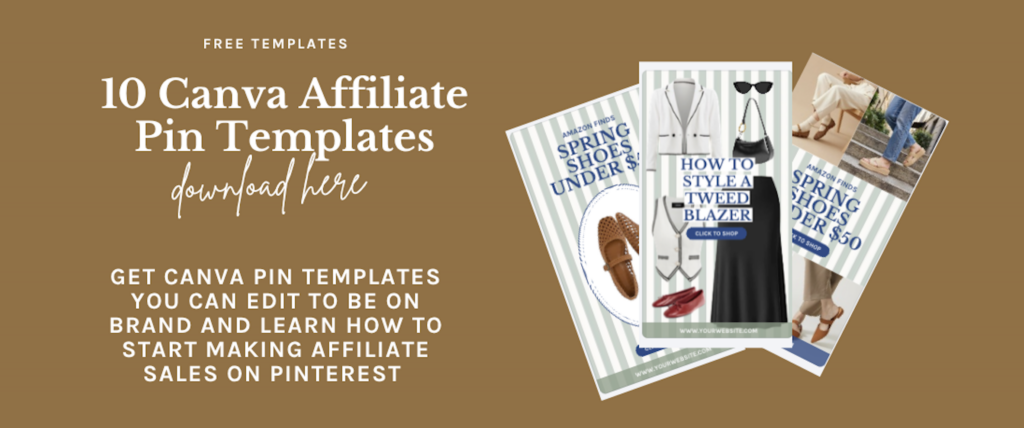
If you’re a creator using Pinterest + ShopMy and any of this is resonating (or making you slightly nervous about your current setup), here’s the easiest place to start. I made a free download for you: 10 Canva Affiliate Pin Templates + a 9-Day Email Series.
The templates are the same kind of pins I’ve built for hundreds of clients over the years. ShopMy style affiliate content, mobile-friendly and with room for the keyword-forward text overlays that will help your content actually surface on Pinterest.
I’ve also just opened a $97 audit specifically for creators using Pinterest + ShopMy.
I’m not leaving my blogger clients behind. I love bloggers. I still believe in long-form content. What I’m doing is meeting a new type of creator where they actually are right now: starting from affiliate-first content, building ShopMy collections… no blog required.
Same 8 years of Pinterest expertise. New focus: Pinterest → ShopMy. And I’ll keep being honest with you about which parts I have nailed and which parts we’re all still figuring out together.